Monthly vs Annual Subscriptions: Which Actually Saves Money?
By Costlarity Editorial Team · Published June 7, 2026 · Updated June 7, 2026
Annual billing is usually cheaper than paying monthly. Whether it actually saves you money depends on something the discount doesn't tell you: how much of the year you'll use what you've prepaid for.
Want to compare both billing options?
The Subscription Cost Calculator shows your monthly, annual, and five-year totals — plus an estimate of what switching to annual plans would save. Takes about two minutes. No signup.
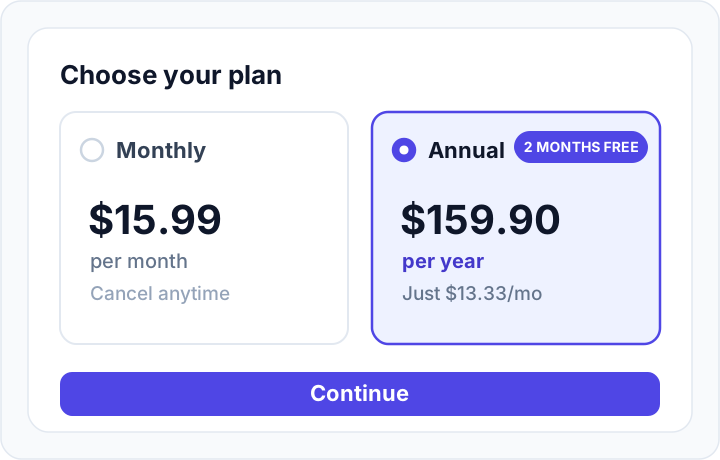
The choice between monthly vs annual subscriptions looks like a straightforward price question: the annual plan costs less per year, so the annual plan wins. On the sticker price, that's usually true. Most services price the yearly plan below twelve months of the monthly rate, and a common structure is "two months free" — you pay for ten months instead of twelve.
But the annual discount is conditional. It only becomes a real saving if you use the service for the full term. The decision isn't really "which price is lower." It's "is the lower price worth paying the whole amount upfront and committing to a year before you know whether you'll still want it." If you want to see how this plays out across your own list, the Subscription Cost Calculator compares monthly and annual totals side by side in about two minutes.
What annual billing actually changes
Switching a subscription from monthly to annual changes three things at once, and they don't all point in the same direction.
The first is price. The yearly plan is discounted against twelve monthly charges — typically by something in the range of 10% to 20%, though the exact figure is set by each provider and isn't standardized. The second is timing: instead of a small charge spread across twelve dates, you pay the full year in a single charge upfront. The third is commitment. You've now bought a year of the service, and if you stop using it, the money is already spent.
The price change is the one that gets advertised. The other two are the ones that determine whether the discount is real for you. A lower yearly price is only a saving if you'd have kept paying monthly for the whole year anyway.
How the discount compounds across multiple subscriptions
On a single subscription, the annual discount looks minor. Ten dollars here, twenty there. It's easy to decide it isn't worth the upfront payment. The picture changes when you apply the same discount across every subscription you'd keep for a full year, because the savings add up the same way the costs do.
Here's a typical set of services priced both ways, using the "two months free" model — annual price equal to ten months of the monthly rate:
Illustrative example — not your actual result
Five subscriptions: monthly billing vs annual plans
Annual prices set at ten months of the monthly rate ("two months free"). Real discounts vary by service; use your own prices for an accurate comparison.
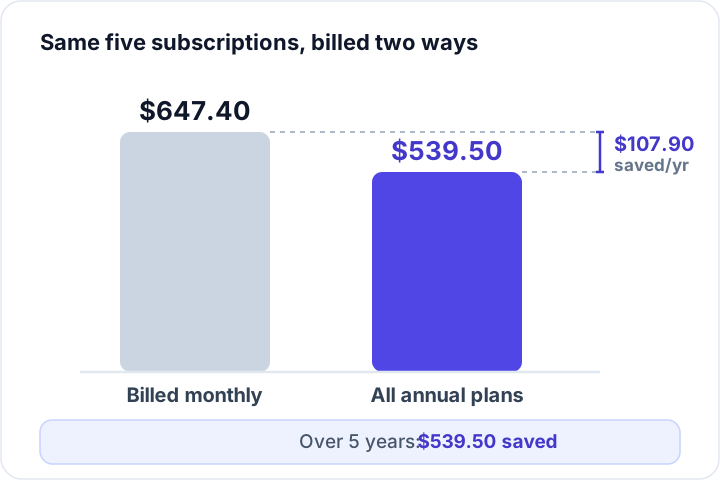
No single line is large. The biggest individual saving is under $32 a year. But the same discount applied across five services is $107.90 a year, and over five years it's $539.50 — roughly a full year of those subscriptions, recovered just by changing how they're billed. That's the case for annual billing, stated plainly. The condition attached to it is the rest of this article.
The upfront payment, and why it feels different
Monthly billing breaks the cost into twelve small charges that process automatically. Annual billing presents the same year as one larger number, paid now. The annual total is identical to twelve monthly charges minus the discount — but it doesn't feel identical, because a single visible payment registers as a cost in a way that twelve quiet autopays don't.
Research on how payment form affects cost perception has found that the more abstract or automatic a payment is, the less it registers as an expense.[1] Monthly autopay is about as frictionless as payment gets, which is part of why the monthly figure feels so manageable. The annual charge is the opposite: one number, paid deliberately, hard to ignore. That salience is uncomfortable, but it's also the honest version of the cost. Why monthly payments feel smaller than they are covers this framing effect in detail — the same annual amount looks different depending on the unit it's presented in.
The practical issue with the upfront payment isn't psychological, though. It's that paying for a full year in advance is a bet that you'll want the service for the full year. The monthly plan lets you reconsider every month. The annual plan asks you to decide once, for twelve months, and pay accordingly.
What you give up: cancellation flexibility
The clearest cost of annual billing is the loss of an exit. With a monthly plan, stopping is simple: you cancel, and the charges stop the next cycle. With an annual plan, you've already paid for the term. Cancelling partway through usually means you keep access until the term ends, but the money for the unused months is gone — refunds for the remaining period are the exception, not the rule.
Annual plans also auto-renew by default in most cases, which means the commitment quietly repeats unless you take action before the renewal date. The FTC has documented that auto-renewing, negative-option billing arrangements are a common source of charges consumers report as unwanted after the fact — the renewal happens on schedule whether or not the subscription is still being used.[2] With annual billing, that renewal is a full year at a time.
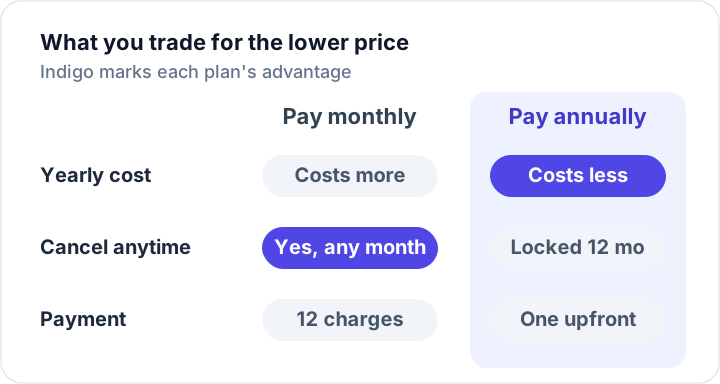
This is the tradeoff in one line: the annual plan trades a lower yearly price for a year of locked-in commitment. Whether that trade is worth it depends entirely on how confident you are about the next twelve months.
The real risk: paying for a year you don't use
The annual discount assumes full-term use. The risk is that people are consistently bad at predicting their own future use — and they err in the optimistic direction.
Behavioral economics research on contract choice documents this directly. In a study of gym memberships, people who chose commitment contracts over per-visit pricing attended far less than their choice implied they expected, because they overestimated how consistently they'd show up.[3] The same authors found across contract types that people systematically expect their future behavior to be more disciplined and consistent than their past behavior actually was.[4] The future self who uses the subscription every week always looks more likely than the past self's usage pattern would justify.
Applied to annual billing, this is the trap: the discount looks like a saving at the moment of signup, when you're imagining a full year of use. If actual use tapers off after a few months — as it often does — the prepaid annual plan can end up costing more than monthly billing would have, because monthly billing could have been stopped when use stopped. The discount is only a discount against the version of the year where you stay the whole way through.
How to decide which plan is worth it
The decision comes down to a single question per subscription: are you confident you'll use this for the full year? The honest answer sorts most services cleanly.
- Go annual on the services you've used consistently for at least a year. If it's already proven itself across twelve months, the commitment risk is low and the discount is close to free money. This is where the compounding savings in the example above actually land.
- Stay monthly on anything new, seasonal, or uncertain. For a service you've had for a few weeks, or one you use only part of the year, the flexibility to stop is usually worth more than the discount. Monthly billing is the cheaper choice the moment you cancel earlier than a year.
- Set a renewal reminder for every annual plan. Auto-renewal turns a one-year commitment into an indefinite one. A calendar note a week before each renewal date restores the yearly re-decision the billing structure removes.
- Run the actual numbers before switching several at once. The discount rate differs by service, so the combined saving isn't a fixed percentage. Comparing your real prices is the only way to know what annual billing saves across your specific list.
Switching every eligible subscription to annual could recover a meaningful amount over five years — but only for the ones you'd genuinely keep that long. The same logic that makes recurring charges easy to overlook in the first place is covered in subscription costs over time, and the spreading-into-smaller-units effect shows up again in buy-now-pay-later billing, where a single price is split into installments that each feel smaller than the whole.
None of this is meant to push you toward one billing cycle. It's just the arithmetic and the conditions attached to it. The annual discount is real. So is the commitment. Knowing both is what makes the choice an actual decision rather than a default.
See what you're actually paying
The Subscription Cost Calculator adds up your subscriptions and shows monthly, annual, and five-year totals — plus an estimate of what switching to annual plans would save. No signup required.
Run the calculatorIf you want to go further on how a full subscription list accumulates over time: Subscription costs over time →
Frequently asked questions
Do annual subscriptions actually save money?
How much cheaper are annual plans than paying monthly?
When is monthly billing the better choice?
What happens to an annual subscription if I cancel partway through?
How do I compare the monthly and annual cost of my subscriptions?
Sources
-
[1] Drazen Prelec & Duncan Simester (MIT Sloan School of Management) — "Always Leave Home Without It: A Further Investigation of the Credit-Card Effect on Willingness to Pay"
https://web.mit.edu/simester/Public/Papers/Alwaysleavehome.pdf -
[2] Federal Trade Commission — "Negative Option Subscriptions"
https://consumer.ftc.gov/articles/negative-option-subscriptions -
[3] Stefano DellaVigna & Ulrike Malmendier (University of California, Berkeley) — "Paying Not to Go to the Gym," American Economic Review, 96(3), 694–719 (2006)
https://www.aeaweb.org/articles?id=10.1257/aer.96.3.694 -
[4] Stefano DellaVigna & Ulrike Malmendier — "Contract Design and Self-Control: Theory and Evidence," Quarterly Journal of Economics, 119(2), 353–402 (2004)
https://academic.oup.com/qje/article/119/2/353/1894024
Related guides and calculators
Subscription Cost Calculator
Add up your subscriptions and compare monthly, annual, and five-year totals, plus estimated annual-plan savings.
Calculate now →Subscription costs over time
How recurring charges accumulate across months, years, and five-year totals — the full picture behind monthly billing.
Read the guide →Why monthly payments feel smaller than they are
How billing cycles and the unit of measurement change what the same annual cost looks like at the moment you decide.
Read the guide →Why unused subscriptions are hard to cancel
The autopay and intention mechanisms that keep a subscription billing long after the use stops.
Read the guide →BNPL Cost Calculator
See the full cost of a purchase split into installments — another case where breaking a price into smaller units changes how it feels.
Calculate now →Credit Card Interest Calculator
See how much a deferred cost grows when it's paid over time instead of upfront.
Calculate now →